Ensuring Continued Access to Immediate Lifesaving Integrated Primary Health, WASH and Protection Services for the Rohingya Refugees in Camps 26 and 27, Nhila Union, Teknaf
Project highlights
Camps 26 and 27, Teknaf, Cox's Bazar, Bangladesh
Friends In Village Development Bangladesh (FIVDB)
70,618 Direct Beneficiaries
1 October 2026 – 30 September 2027
Supported by
Project summary
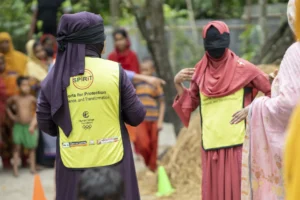
The project, implemented in partnership with Friends In Village Development Bangladesh (FIVDB), provides lifesaving integrated primary health, WASH and protection services for Rohingya refugees in Camps 26 and 27, Teknaf. It delivers 24/7 primary healthcare, safe water, sanitation and hygiene services, and survivor-centred GBV response and prevention, while strengthening community-based support through volunteers, outreach and awareness sessions.
Project goal
The overall objective of this project is to reduce vulnerability and protect the lives, health and dignity of Rohingya refugees in Camps 26 and 27, Cox’s Bazar, through integrated, lifesaving primary healthcare, WASH and Protection – Gender-Based Violence services for people affected by or at risk of disease, violence and other protection risks.
.
Key activities
GBV
Provide survivor-centred GBV case management
Share GBV prevention and risk-mitigation information.
Health
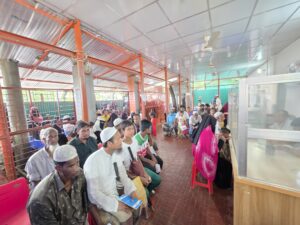
Provide 24/7 essential primary healthcare services through two Primary Healthcare Centers (PHCs) in Camps 26 and 27, serving Rohingya refugees.
Provide essential maternal and reproductive healthcare, including Basic Emergency Obstetric and Newborn Care (BEmONC), Ante-Natal Care (ANC), Post-Natal Care (PNC), Family Planning
Provide treatment for communicable and non-communicable diseases.
Refer children with Severe Acute Malnutrition (SAM) and Moderate Acute Malnutrition (MAM) for nutrition care, alongside Infant and Young Child Feeding (IYCF) counselling.
Serve an average of 655 patients per day, providing approximately 239,075 consultations annually.
WASH
Operate the Camp 27 desalination plant and water distribution network.
Run the Camp 26 fecal sludge and solid waste management plants.
Maintain, decommission and construct latrines and bathing cubicles.
Conduct hygiene promotion and distribute hygiene kits.
Train Water User Groups on operation and maintenance